

Dragon Staircase & Salamander (El Drac)
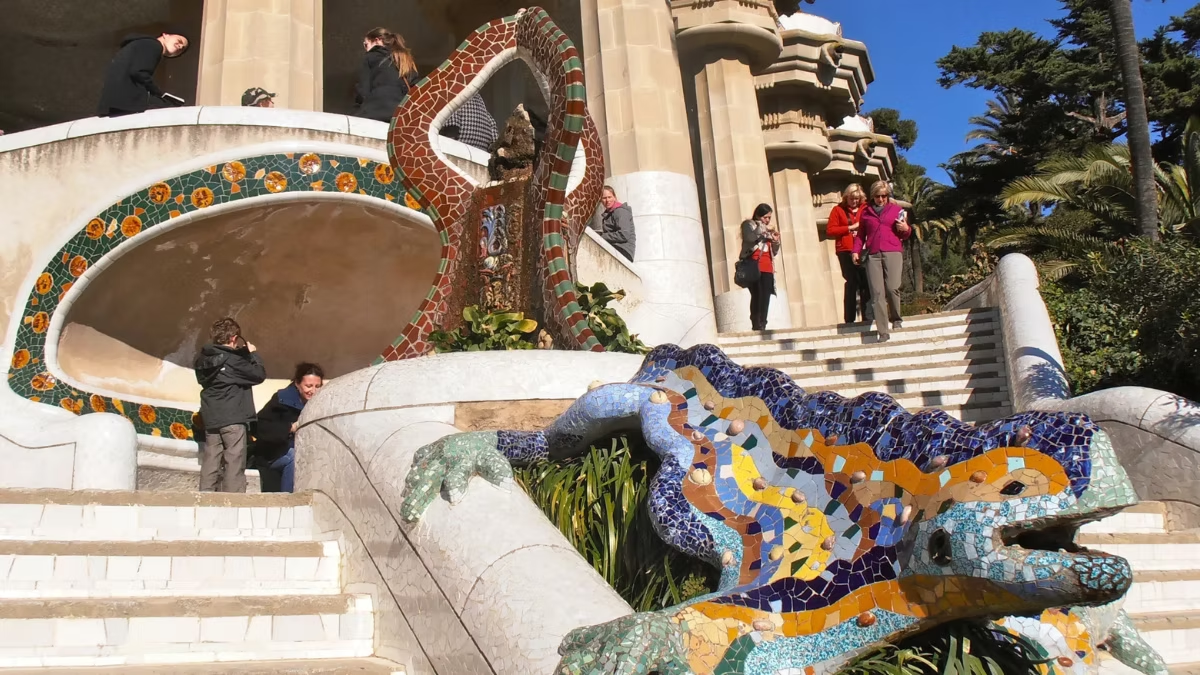
The Dragon Staircase is the grand double staircase at the main Carrer d’Olot entrance to Park Güell’s Monumental Zone. The mosaic creature halfway up — known as El Drac (“the dragon” in Catalan) — is technically a salamander, and is the most photographed landmark in the park. It sits above the overflow outlet of a 1,200 cubic metre underground cistern. The staircase was built between 1900 and 1914 and is included with the standard €18 admission ticket.
Almost every photograph taken of Park Güell features El Drac. The blue-green-gold mosaic creature on the entrance staircase has become the symbol of the park, the symbol of the Gaudí Year 2026, and one of the most recognisable images in all of Barcelona. But the story behind it — what it actually is, what it sits on, and why it is there — is considerably more interesting than the photograph suggests.
What Is the Dragon Staircase?
The Escalinata del Dragón is the grand double entrance staircase at the Carrer d’Olot gate, divided into three ascending flights with retaining walls and grottos on either side. El Drac — the mosaic salamander — sits on the second landing above the Catalan coat of arms. The staircase is approximately 20 metres wide at its base.
The Escalinata del Dragón (Dragon Stairway) is the grand entrance sequence to the Monumental Zone, rising from the main esplanade at Carrer d’Olot up to the Hypostyle Room and Main Terrace above. It is divided into three ascending flights separated by small landings, flanked by retaining walls with battlements (merlons) that form terraced areas on either side. Two grottos are set into the walls on either side of the lowest flight — the right-hand one served as a waiting shelter for estate residents, supported by a single conical stone column.
The staircase runs the full width of the main entrance and is approximately 20 metres wide at its base.
El Drac: Dragon, Lizard, or Salamander?
The mosaic creature halfway up the central flight of the staircase is the subject of persistent debate. The official Park Güell website calls it “the dragon, or salamander.” The animal is anatomically a salamander — it has the body, tail, and leg structure of a salamander rather than a dragon. But Barcelonins have always called it El Drac (the dragon in Catalan), and the name has stuck.
The distinction matters more for the symbolism than the taxonomy:
As a salamander: In alchemical and mythological tradition, the salamander is an animal that lives in fire — it was believed to extinguish flames by wrapping itself around them. For Gaudí, who embedded deep symbolism into every element of the park, the salamander represented purification, rebirth, and resistance. Some historians read it as the guardian of the underground cistern below — the creature that controls the water flowing from the park’s drainage system.
As a dragon: The dragon in Catalonia is inseparable from the legend of Sant Jordi (Saint George), the patron saint of Catalonia, who slew a dragon to save a princess. Barcelona has over 400 dragon representations across the city. Placing a dragon at the entrance to Park Güell connects it to Catalan identity and the Modernisme movement’s celebration of Catalanism.
The Greek mythology reading: Some scholars connect El Drac to Ladon — the serpent that guarded Hera’s golden apples in the Garden of the Hesperides in Greek mythology. Gaudí, who was deeply read in classical sources, may have intended the park as a garden of paradise with its guardian at the gate.
All three readings likely coexist intentionally. Gaudí was not a man who designed one meaning into a symbol when several could be layered simultaneously.
The Staircase’s Hidden Function
El Drac sits above the overflow outlet of a 1,200m³ underground cistern beneath the Hypostyle Room. Rainwater from the Main Terrace passes through hollow Hypostyle columns, collects in the cistern, and exits through El Drac’s mouth when full. The fountain elements along the staircase are part of the same integrated water management system.
The Dragon Staircase is not primarily decorative. It is the visible end of an engineered water management system that runs through the entire Monumental Zone.
Rainwater falling on the Main Terrace above is collected by drainage holes in the Serpentine Bench's backrest, channelled through the hollow columns of the Hypostyle Room below, and accumulated in a 1,200 cubic metre cistern buried beneath the room. El Drac sits directly above this cistern’s overflow outlet — when the cistern fills to capacity, excess water pours from the creature’s mouth, running down the central spine of the staircase in a controlled fountain.
The water fountains along the staircase also include a lower sculpture (sometimes described as a snake) that refers to the Catalan flag, and the Catalan coat of arms appears on the second landing above. The staircase is simultaneously a water feature, a piece of public art, and a political statement about Catalan identity.
The Three Fountains of the Staircase
Three fountain elements punctuate the central spine of the staircase as it ascends:
- First landing: A circular motif said to represent the world, interlaced with a compass — the tool of an architect. Water flows through imitation tree trunks around it.
- Second landing: A dragon’s head emerging from the Catalan flag — a direct reference to the legend of Sant Jordi.
- El Drac (third landing): The salamander/dragon, overflow outlet of the cistern. The most famous and most photographed.
The Trencadís Technique on El Drac
El Drac is approximately 2.4 metres long, built on a concrete base and covered entirely in trencadís mosaic — the technique of breaking ceramic tiles, glass, and crockery into irregular fragments and assembling them into curved surfaces. The result gives El Drac its distinctive shimmering quality: no two tiles are the same size or angle, so the surface catches light from multiple directions simultaneously, creating the effect of scales.
Gaudí used discarded tiles from a nearby factory rather than buying new ceramic pieces. The material waste of the tile industry became the raw material of one of the world’s most famous public sculptures. The asymmetrical arrangement of differently shaped fragments — which Gaudí believed better reflected nature’s own imperfect perfection — became his signature across Casa Batlló, the Serpentine Bench, and the Sagrada Família towers.
Photography Tips
| Timing | Crowd Level | Light Quality |
|---|---|---|
| 09:30–10:00 | Lightest | Morning light from south-east — warm, directional |
| 10:00–11:00 | Light | Still good |
| 11:00–15:00 | Peak | Harsh overhead — mosaics look washed out |
| 15:00–17:00 | Thinning | Improving afternoon light |
| Last tourist slot (~18:30 summer) | Light | Warm golden light — excellent for colour saturation |
Best angle: Stand at the base of the staircase looking up, with both Porter’s Lodge pavilions visible in the background. This gives the full context of the entrance and makes El Drac appear as a guardian of the passage above.
Clean shot strategy: Arrive at the 09:30 slot and go directly to El Drac before the first guided tour groups arrive. By 10:30 a queue of visitors wanting to pose with the creature forms and waits an average of 5–10 minutes for a clear shot. Before 10:00 on a weekday in spring or autumn, you can often photograph El Drac without anyone in the frame.
Midday is the worst time: The overhead sun creates flat, washed-out colour on the mosaics and harsh shadows under El Drac’s body. The same tiles that glow gold in morning or late afternoon light look dull grey-green at noon.
Conservation
El Drac underwent a significant restoration in 2007 to repair mosaic damage from decades of visitor contact and weathering. The park management asks visitors not to touch the sculpture. Conservation of the trencadís surfaces is ongoing — recent works on the Serpentine Bench above have used the same discarded-ceramic approach Gaudí pioneered, replacing damaged fragments with new pieces broken to match the originals.
Frequently Asked Questions
Is it a dragon or a salamander?
Technically a salamander by its anatomy. Called El Drac (“the dragon”) by everyone in Barcelona. The ambiguity is intentional — Gaudí embedded multiple symbolic readings.
Can I touch El Drac?
No. The mosaic tiles are fragile and visitor contact causes damage. The park asks visitors not to touch the sculpture, and staff enforce this.
Is the Dragon Staircase included in the standard ticket?
Yes. The €18 adult admission ticket covers the full Monumental Zone including the Dragon Staircase.
Why does El Drac have water coming from its mouth?
El Drac sits above the overflow outlet of the underground cistern beneath the Hypostyle Room. When the cistern fills with rainwater from the terrace above, excess water exits through El Drac’s mouth.
When was El Drac restored?
A significant restoration was completed in 2007. Ongoing maintenance continues.
