

Views & Photography Spots at Park Güell
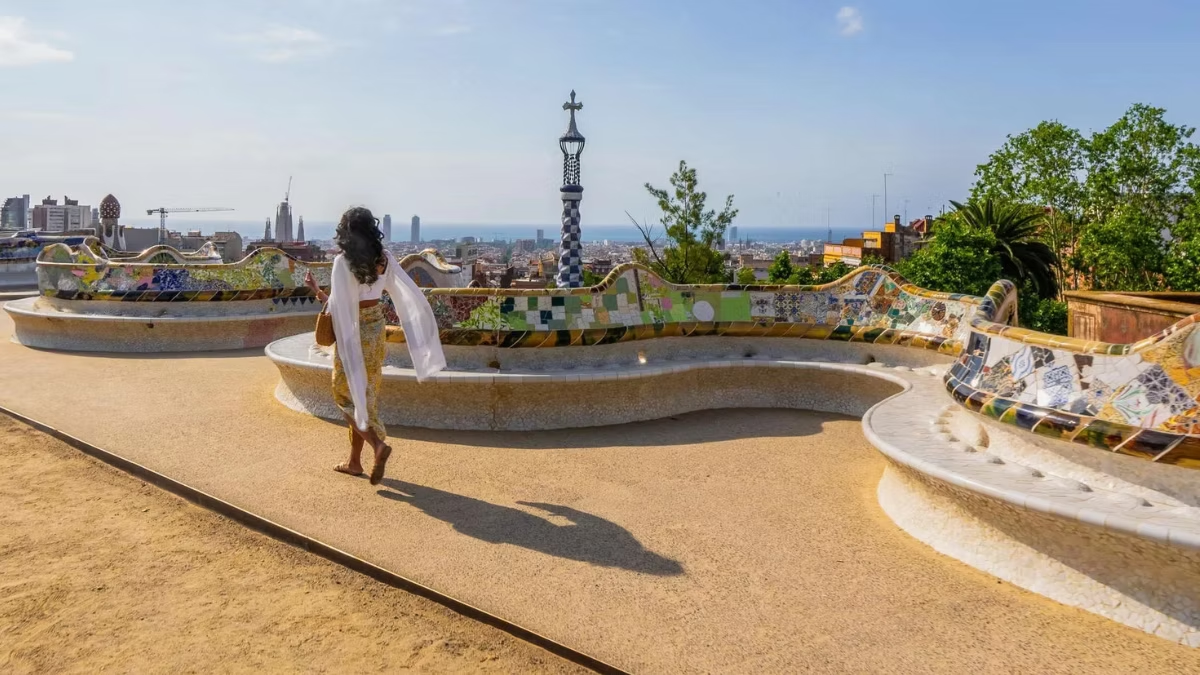
The best photography spots at Park Güell are the Serpentine Bench for panoramic city views, El Drac for architectural detail, the Hypostyle Room for interiors, and the Turó de les Tres Creus for a free hilltop panorama. Morning light (09:30–11:00) is best for the Dragon Staircase and bench mosaics. The last entry slot (around 18:30 in summer) is best for golden hour on the terrace. Tripods are not permitted inside the Monumental Zone. No drones.
Park Güell rewards photographers who plan. The same shot taken at 09:30 on a Tuesday in May and at 13:00 on a Saturday in July are not the same photograph — different light, different crowds, different atmosphere. This guide covers the specific shots available at each spot, the best angles and equipment choices, and the exact timing that produces the best results.
Photography Rules
Personal photography and personal video are permitted throughout the park. Tripods are not permitted inside the Monumental Zone during regular visiting hours. Drones require advance written permission from BSM (parkguell@bsmsa.cat) — general visitor tickets do not include drone authorisation. Flash is not permitted near trencadís surfaces. Commercial photography requires a separate BSM permit.
| Rule | Notes |
|---|---|
| Personal photography | Permitted throughout the park including the Monumental Zone |
| Video (personal use) | Permitted |
| Tripods | Not permitted inside the Monumental Zone during regular visiting hours |
| Drones | Not permitted without advance written permission from BSM (parkguell@bsmsa.cat) |
| Flash | Not permitted inside the Hypostyle Room or near the trencadís surfaces |
| Commercial photography | Requires a separate permit from BSM |
Spot 1: El Drac (Dragon Staircase)
Best shot: stand slightly below El Drac, looking up the staircase with both Porter’s Lodge pavilions visible in the background. Arrive at 09:30 for the clearest chance of an unobstructed frame — by 10:30 a queue forms. Morning light from the south-east catches the mosaic scales at a flattering angle; midday overhead sun washes out the colour entirely.
Zone: Monumental (paid) | Best time: 09:30–10:00 (weekday) or last entry slot
The shot: El Drac is best photographed from slightly below — stand at the base of the second flight looking up, with El Drac centred and both Porter’s Lodge pavilions visible in the background. This gives the creature its “guardian of the gate” quality that the standard eye-level portrait shot misses.
Detail photography: Position yourself at the same level as the mosaic surface and shoot laterally across it. The trencadís fragments catch directional light at this angle, revealing the texture and individual tile variation that overhead shots flatten into a uniform sheen.
Crowd management: El Drac is the most congested single spot in the park. By 10:30, a queue of visitors forms. The 09:30 entry slot on a mid-week day in April, May, October, or November is the realistic minimum for a relatively clear shot. At midday in July, expect to wait 10–15 minutes for a gap.
Light: Morning light from the south-east hits El Drac from the right side, creating depth and shadow in the mosaic scales. Overhead midday sun flattens everything to a dull green-grey. Late afternoon light returns warmth to the surface.
Spot 2: Serpentine Bench and Main Terrace
Classic panorama: stand at the western end of the terrace and shoot east along the bench toward Barcelona. Morning light warms the bench and city simultaneously; golden hour turns the city amber. For bench detail photography: crouch at seat level and shoot along the mosaic surface — this reveals the individual fragment variety that standing shots miss entirely.
Zone: Monumental (paid) | Best time: 09:30–10:30 (bench detail) or last entry slot (panorama)
The classic panorama shot: Stand at the western end of the terrace and shoot east along the bench toward Barcelona. The Serpentine Bench curves away from you, leading the eye toward the city below. In the morning, the south-east sun warms both the bench and the city simultaneously. At golden hour, the city turns amber.
The bench detail shot: Crouch at bench level and shoot along the mosaic surface. This reveals the individual tile fragments, their different origins and glazes, the drainage holes in the backrest, and the texture that disappears in standard standing shots. Use a moderate wide angle rather than extreme wide — vertical distortion in extreme wide angles works against the horizontal sweep of the bench.
The terrace panorama (for views alone): The bench’s western end gives the best framing of the Barcelona skyline with the Eixample grid and Sagrada Família on axis. On the clearest days — typically after autumn rain — the Mediterranean is visible on the horizon.
Crowd management: The terrace is the most photographed part of the park. The first 20–30 minutes after the 09:30 slot opens is the quietest. From 11:00, a continuous flow of visitors makes a bench-only composition difficult. The last entry slot (18:30 in summer) is the second best option — golden light, thinning crowd.
Spot 3: Hypostyle Room
Best column forest shot: stand at the eastern end and shoot west along the colonnade with a wide-angle lens (16–24mm). The light enters from the open terraces at both ends, creating a natural gradient. For ceiling medallions: position yourself directly below the largest medallion and shoot straight up. The last entry slot gives the quietest conditions inside.
Zone: Monumental (paid) | Best time: 09:30–10:00 or last entry slot
The column forest shot: Stand at the eastern end of the room and shoot west along the length of the colonnade. A wide-angle lens (16–24mm equivalent) captures the receding columns well. The light enters from the open terraces at both ends, creating a gradient across the ceiling.
Looking up at the medallions: Position yourself directly below the largest of Jujol’s four ceiling medallions and shoot straight up. The trencadís fragments catch light differently from directly below — the colours appear more saturated than from a standing angle.
Column base detail: The hollow column bases have small drainage outlet holes visible at floor level. This is a detail almost no visitor notices and almost no photograph captures — a close-up here tells the story of the water management system more clearly than any description.
Crowd management: The Hypostyle Room is a bottleneck. Groups cluster in the centre and around El Drac at the entrance end. The clearest compositional space is in the western nave sections where the columns are more widely spaced.
Spot 4: Laundry Room Portico
Zone: Monumental (paid) | Best time: Any — consistently quiet
The Laundry Room Portico on the eastern edge of the Main Terrace is consistently the least crowded spot in the Monumental Zone. The inclined columns creating a wave-like covered walkway are a distinctive subject that most visitors never photograph. The best angle is from inside the portico looking out — the columns frame the terrace above and the park below in a composition that is uniquely structured.
Spot 5: Turó de les Tres Creus
The best free panoramic viewpoint in Barcelona — and on a clear day, superior to the Main Terrace for breadth of view. Shoot south for the Eixample grid with Sagrada Família on its axis. The three iron crosses provide a natural foreground for sunset shots. No ticket, no closing time, no crowds. The best time: 45–60 minutes before sunset.
Zone: Free (no ticket) | Best time: Golden hour or any clear day
The highest point in the park at 182 metres offers the widest panorama available anywhere in Park Güell — and it is free. The Barcelona skyline with the Eixample grid, the Sagrada Família on its central axis, Montjuïc, the Mediterranean, and Tibidabo silhouette are all visible simultaneously.
The sunset shot: Position yourself on the summit 45–60 minutes before sunset. The Tibidabo ridge to the north-west catches the last light while the city below transitions from golden to amber. The three iron crosses provide a natural foreground.
The city axis shot: Stand at the southern edge of the summit and shoot south with a moderate telephoto (50–85mm equivalent). The Eixample grid compresses into a pattern with the Sagrada Família towers rising from it. This is the shot that makes the relationship between the park and the city most legible.
No time pressure: Unlike the Monumental Zone, the free zone has no closing time during park hours. You can stay at the summit until the light is gone without rushing.
Spot 6: The Viaducts
Zone: Free (no ticket) | Best time: Morning or afternoon (avoid harsh midday overhead light)
The viaducts are the most underused photography location in Park Güell. Their organic column structure, the way the stone merges with the hillside, and the dappled light through the pine canopy above create compositions entirely unlike the mosaic-and-panorama shots that dominate Park Güell photography.
Shooting the columns: Position yourself below a viaduct and shoot up through the inclined columns toward the pathway above. The leaning geometry creates natural diagonal lines. In morning light, the sun catches the rough-cut stone from the side.
The path looking north: From within the Middle Viaduct, looking north into the forest, the path curves away through pine trees with the stone structure above. This is the park’s most “green and natural” composition — a reminder that Park Güell was also an ambitious landscape project, not just an architectural one.
Timing Summary
| Spot | Best Morning Slot | Best Evening Slot | Worst Time |
|---|---|---|---|
| El Drac | 09:30–10:00 | Last entry slot | 11:00–15:00 in summer |
| Serpentine Bench | 09:30–10:30 (bench detail) | Last entry slot (panorama) | 12:00–15:00 |
| Hypostyle Room | 09:30–10:00 | Last entry slot | 11:00–14:00 |
| Laundry Room Portico | Any morning | Any | N/A — always quiet |
| Turó de les Tres Creus | Sunrise (free zone) | Golden hour / sunset | Harsh midday in summer |
| Viaducts | Morning (side light on stone) | Late afternoon | N/A — rarely crowded |
Equipment Notes
Lens choice: A moderate wide angle (24–35mm equivalent) suits most Park Güell subjects. The Hypostyle Room benefits from wider (16–24mm) for the column-forest effect. The Turó de les Tres Creus benefits from moderate telephoto (50–85mm) for the city axis shot. Extreme wide angles tend to distort the organic curves of the bench and columns.
Polarising filter: Useful on the trencadís surfaces, which reflect sunlight aggressively at midday. A polariser reduces glare and deepens the mosaic colours significantly.
Tripod: Not permitted inside the Monumental Zone. Hand-held shooting in the Hypostyle Room in low light (last entry slot) requires either a fast lens or willingness to push ISO.
Frequently Asked Questions
What is the best photography spot in Park Güell?
The Serpentine Bench at golden hour (last entry slot in summer) for the most atmospheric panorama. El Drac at 09:30 for the most iconic single subject. Turó de les Tres Creus at sunset for the best free viewpoint.
Are tripods allowed?
Not permitted inside the Monumental Zone during regular visiting hours. Permitted in the free zone.
Are drones allowed?
No — not without advance written permission from BSM. Contact parkguell@bsmsa.cat.
What is the best time of day for photography?
09:30–10:30 (morning light, thinner crowds) or the last tourist entry slot — see our Park Güell at Sunset guide (~18:30 in summer, ~16:30 in winter) for golden hour.
Can I do a professional photoshoot at Park Güell?
Professional or commercial shoots require a separate permit from BSM. Personal and travel photography is permitted throughout the park.
